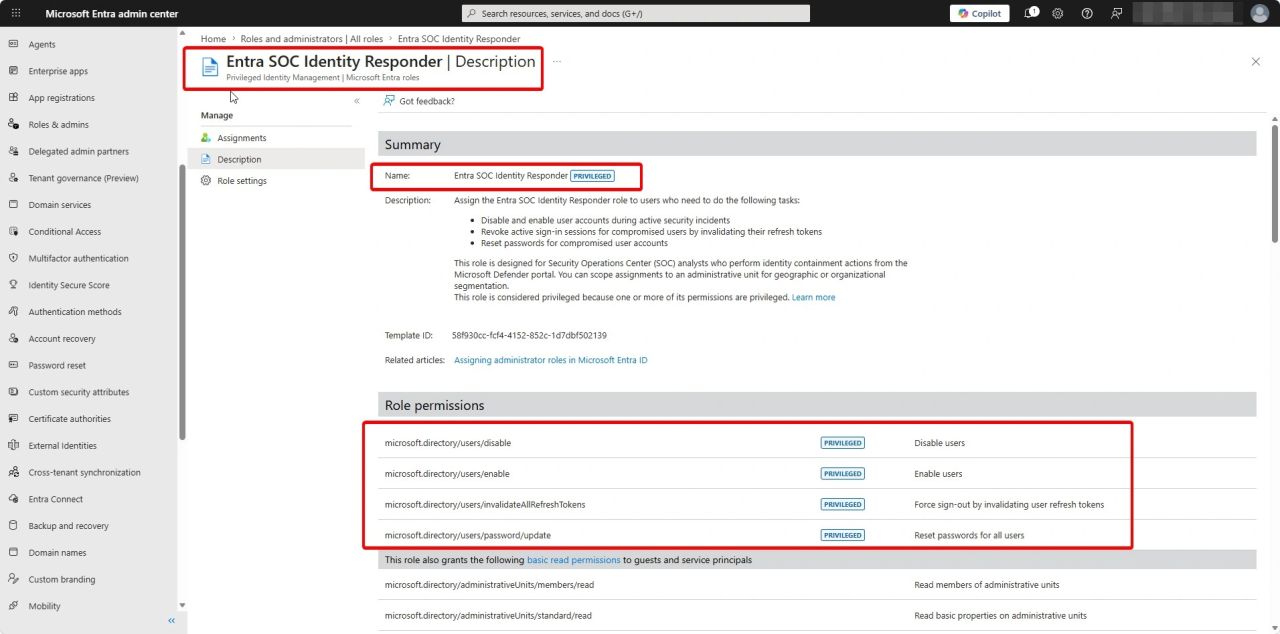
🚨 Microsoft Entra introduces the new SOC Identity Responder role—helping Security Operations Centers respond to identity threats faster while maintaining least-privilege access.
When a user account is compromised, every second counts. Traditionally, SOC analysts often had to wait for an Identity Administrator—or be granted broader administrative permissions—to perform containment actions.
Microsoft's new SOC Identity Responder built-in role changes that by giving security teams the permissions they need to respond quickly, without requiring full identity administration rights.
🔐 What can the role do?
Authorized SOC analysts can:
✅ Disable and re-enable compromised user accounts ✅ Revoke active sign-in sessions by invalidating refresh tokens ✅ Reset passwords for compromised users ✅ Perform identity containment actions directly from Microsoft Defender's unified RBAC experience
🌍 Granular delegation
The role can also be scoped to an Administrative Unit (AU), allowing organizations to delegate identity response responsibilities by region, department, or business unit while limiting administrative exposure.
🛡️ Secure it with PIM
Although purpose-built for incident response, this remains a privileged role because it includes sensitive actions such as disabling accounts and resetting passwords.
For stronger governance, consider assigning it through Microsoft Entra Privileged Identity Management (PIM) using:
🔹 Just-in-Time (JIT) activation 🔹 Approval workflows 🔹 Multi-Factor Authentication (MFA) during activation 🔹 Time-bound assignments 🔹 Regular access reviews
💡 Why this matters
This is a significant improvement for organizations adopting Zero Trust and least-privilege principles. It enables SOC analysts to contain identity-based attacks more quickly while reducing dependence on highly privileged identity administrators during active incidents.