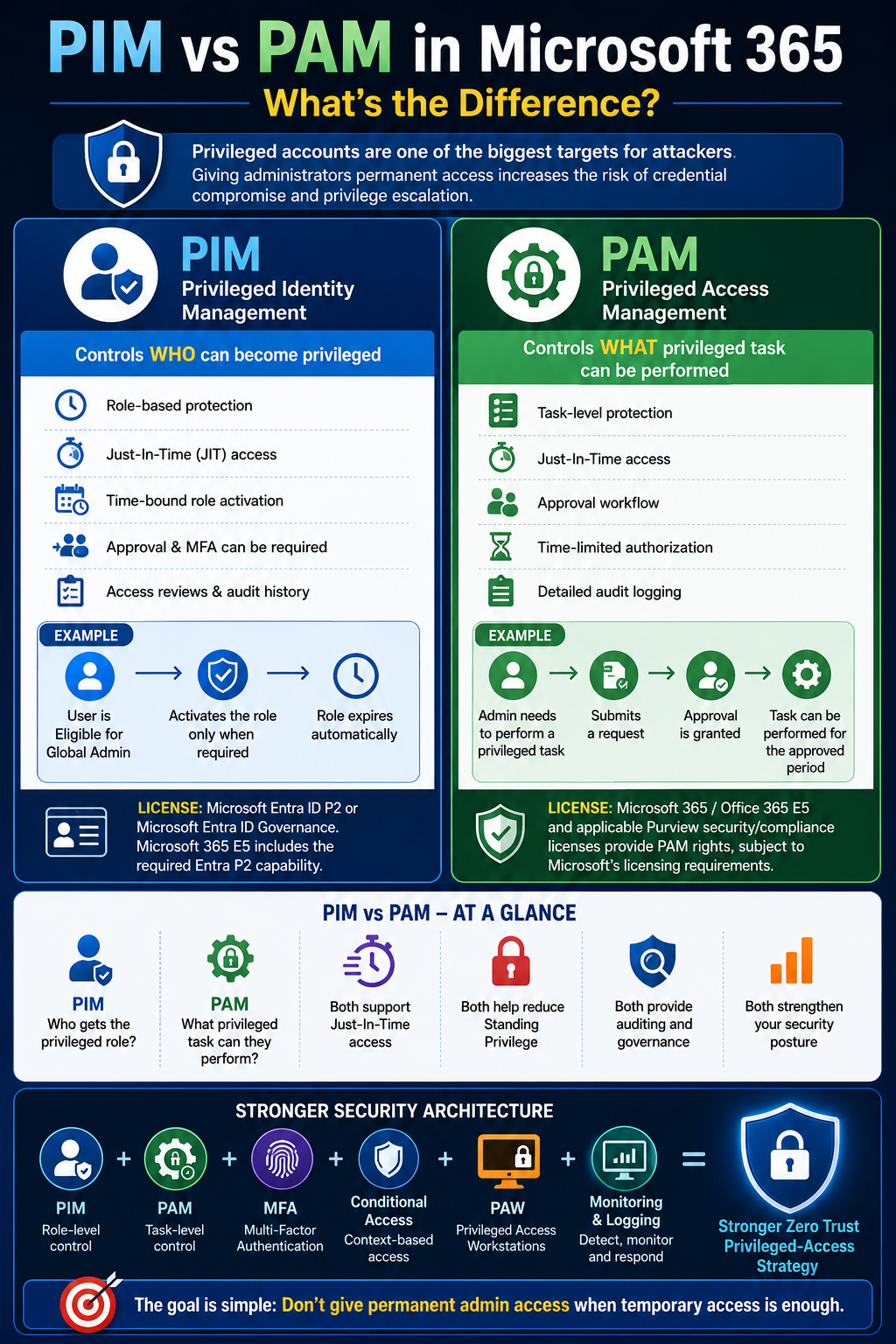
Privileged access is one of the highest-value targets for attackers.
The more administrators with permanent privileges, the greater the potential impact of a compromised account. That's why modern security strategies focus on Just-in-Time (JIT) access instead of standing administrative privileges.
Two Microsoft capabilities you may encounter are PIM and PAM—but they solve different privileged-access problems.
🛡️ PIM — Privileged Identity Management
Think:
“WHO should have the privileged role, and WHEN?”
Microsoft Entra PIM helps manage privileged role assignments by allowing users to become eligible for administrative roles rather than permanently active.
Capabilities include:
🔹 Just-in-Time role activation
🔹 Time-limited privileges
🔹 MFA during activation
🔹 Approval workflows
🔹 Business justification
🔹 Notifications
🔹 Access reviews
🔹 Audit history
📌 Example:
An administrator is eligible for Global Administrator.
Eligible → Request Activation → MFA/Approval → Global Admin Active → Work Completed → Role Expires
The administrator only receives the privileges when they're actually required.
PIM requires Microsoft Entra ID P2 or Microsoft Entra ID Governance licensing for applicable users.
🔒 PAM — Privileged Access Management
Think:
“WHAT privileged task should the administrator be allowed to perform?”
Instead of activating an entire administrative role, PAM focuses on controlling access to specific high-risk or privileged Microsoft 365 tasks through approval and time-bound authorization.
📌 Example:
An administrator needs to perform a sensitive Exchange operation.
Request Task → Approval → Temporary Authorization → Perform Task → Access Expires
This provides another layer of control around particularly sensitive administrative operations.
⚡ PIM vs PAM — Simple Way to Remember
👤 PIM = Role-level privilege
WHO gets elevated access?
⚙️ PAM = Task-level privilege
WHAT privileged operation can they perform?
Both approaches support the same important security principle:
🚫 Reduce standing privilege.
🏆 Building a Stronger Privileged Access Strategy
Privileged access security shouldn't rely on a single control.
A stronger architecture combines:
PIM + PAM + MFA + Conditional Access + Privileged Access Workstations + Monitoring
⬇️
🔐 Stronger Zero Trust privileged-access security
💡 Bottom line: Don't give administrators permanent privileges when temporary, controlled access is enough.
The goal isn't to make administration difficult.
It's to make privilege temporary, intentional, auditable, and harder to abuse.